The exponential growth of Gleisters and the attempt to end the cycle
The Robot Who Looked Like MeThe exponential growth of Gleisters and the attempt to end the cycle is a time-travel crisis that becomes a problem of population, imperial survival, and self-sacrifice. Mingus explains that each time-travel displacement produces another Gleister, multiplying the people caught in the sequence; Hieronymous Gleister proposes an out-of-continuity suicide as a way to make that sequence terminate. The attempt leads not to a clean ending but to a renewed imperial scene in which the roles and deaths still await their turn.
The duplication mechanism
Mingus traces the crisis to the first or original Gleister, who built a time machine and went into the future. Because that departure left a Gleister missing from his normal position, Nature filled the vacancy with an identical or near-identical replacement. The paradox is not a one-time anomaly: every subsequent use of a time machine creates another displacement, and another Gleister appears to fill it.
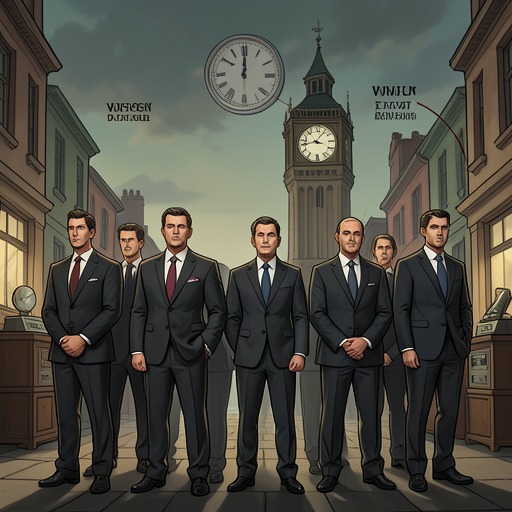
Those duplicates do not remain isolated. Mingus describes multiple Gleister sequences moving through different missions: one becomes the Emperor, another forms an organization against the Emperor, and others follow their own paths. Each time-traveling sequence generates a further duplicate, who may in turn travel and help generate still more. The result is geometric growth: the more Gleisters time travel, the more Gleisters there are to travel. Individual journeys thus feed a process larger than any one of them.
The imperial crisis
The displaced Gleisters come to Mingus because they have nowhere else to go. He has managed to house about twelve million, but the Empire is running out of resources as arrivals become more frequent. The figure makes the paradox tangible: what began as a gap in an individual’s position in time has become a vast population that an imperial government must accommodate.
Mingus considers whether the Army could shoot the newcomers on sight, but rejects the possibility as a solution. Violence against arriving individuals would not control the mounting progression that produces them. He foresees a future in which the Earth is carpeted with Gleisters while new ones continue to pour in. His predicament is therefore not simply a shortage of rooms or supplies. The process replenishes the population faster than ordinary measures can contain it, leaving even the Emperor subject to the temporal mechanism that sustains his power.
A proposed limit
Hieronymous argues that an infinitely expanding series needs a limit if it is to end. He proposes death, introduced early enough to grow alongside the sequence and eventually make it self-limiting and self-canceling. Mingus objects that many Gleisters have already died without stopping the expansion. Hieronymous distinguishes those deaths from the one he believes is needed: the earlier deaths were normal endings of individual time tracks, not a death outside continuity capable of affecting the series itself.
The distinction makes the proposal more exact than a general call for sacrifice. The problem is not that no Gleisters die; it is that their deaths occur within the ordinary structure of the branching process. Hieronymous therefore identifies suicide as a short-term recycling factor that could interrupt the sequence from outside its normal continuity. Mingus first offers to make that sacrifice as his final imperial act. Hieronymous refuses, claiming that he is the original Gleister and that only his suicide can end what he began. He offers intuition, rather than proof, as the basis for that belief.
The suicide and its immediate return
The suicide takes place away from the route, in a landscape connected to childhood memory. The Gleister reaches a stubbled field, crosses woods, and comes to a small brook where he had once caught sunfish. The oak tree is still there. He sits with his back against it, takes out the gun, and looks at it while sunlight lies on the water. After several minutes, he puts the muzzle in his mouth, gags at the oily-metal taste, closes his eyes, and pulls the trigger.
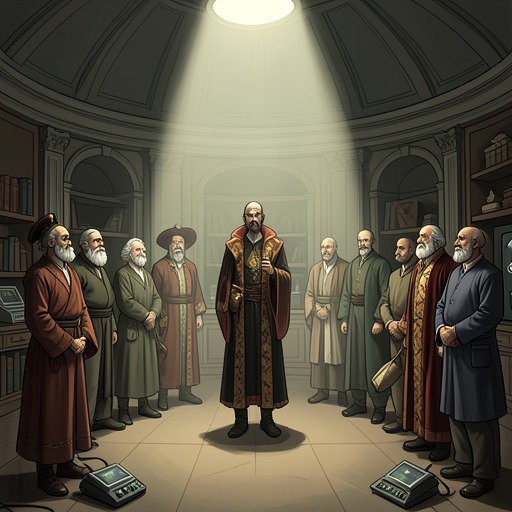
The next scene is explicitly marked as the initial termination recycling. Charlie Gleister opens his eyes in the imperial audience room, with statistics showing that more than twelve million Gleisters have been settled and that more are arriving every minute. Egon Gleister stands before him. Charlie hands him the laser gun, and Egon activates his time machine and disappears. The abrupt return joins the private act of suicide to the continuing machinery of imperial succession and time travel: the death has not removed the Gleister population from the story.
An ending folded back into the cycle
Alone in the audience room, Charlie recognizes that he must take his turn as Emperor, as the other Gleisters must take all the roles in the sequence while the termination proceeds. He is grateful to have completed the suicide part for now, but understands that he will have to do it again, after the others have done it. The ending thus presents death as both a proposed limit and a recurring role. Hieronymous’s belief that the original’s suicide can end what he began remains bound to a process that returns him to the beginning and schedules another performance of the same act.